
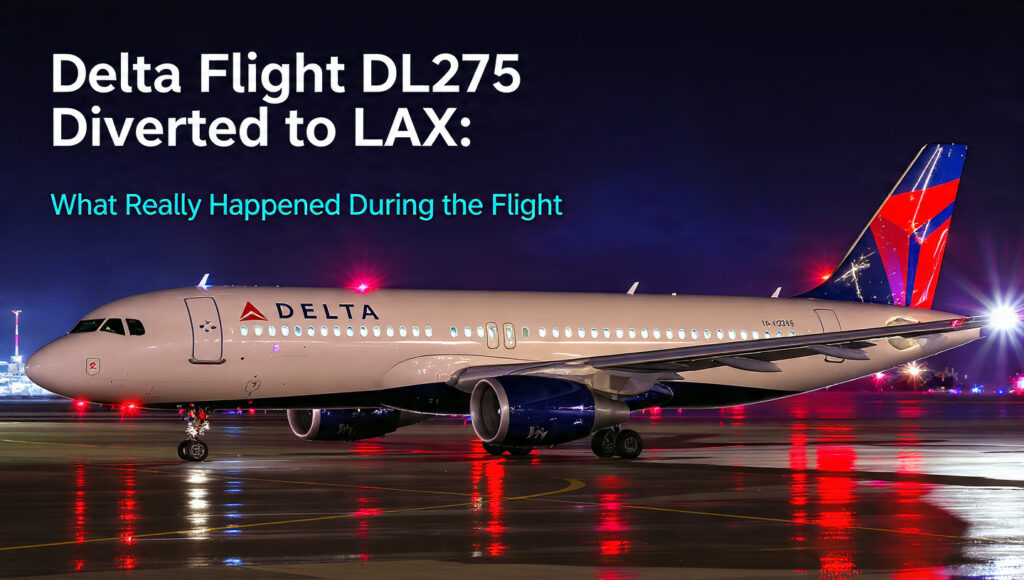
Delta Flight DL275 was scheduled to operate a long-haul international route from Detroit Metropolitan Wayne County Airport to Tokyo Haneda Airport.
For passengers boarding the aircraft, the trip was expected to be a standard trans-Pacific journey lasting more than 13 hours.
However, the flight quickly became a widely discussed aviation event after it unexpectedly diverted to Los Angeles International Airport (LAX).
The diversion raised questions among travelers, aviation enthusiasts, and the general public about what happened mid-flight and why the pilots chose to change course.
While flight diversions are rare, they are part of standard aviation safety procedures.
Understanding the situation behind Delta Flight DL275 provides insight into how modern airlines respond to technical issues while prioritizing passenger safety.
The Original Flight Plan
Delta Flight DL275 operates as a long-distance international route connecting Detroit in the United States with Tokyo in Japan.
The service is typically flown using the Airbus A350-900, one of the most advanced long-range passenger aircraft in the world.
On May 27, 2025, the aircraft departed Detroit in the afternoon after a slight delay caused by a late incoming flight.
Passengers expected a normal overnight journey across the Pacific Ocean toward Tokyo Haneda Airport.
Everything appeared routine during the early stages of the flight.
The aircraft climbed to its cruising altitude and began crossing the northern Pacific flight corridor, which is commonly used for routes between North America and Asia.
But several hours into the journey, the situation changed.
The Mid-Air Technical Issue
During the cruise phase of the flight at around 38,000 feet, the aircraft’s onboard monitoring systems detected an abnormal reading in one of the engines.
Specifically, the issue involved the engine anti-ice system, a critical component designed to prevent ice buildup during high-altitude flight.
At cruising altitude, temperatures outside the aircraft can drop to around −50°C.
Under these conditions, ice can form on engine components, potentially affecting airflow and engine performance if protective systems fail.
The anti-ice system works by directing heated air through engine components to prevent ice formation.
If this system malfunctions, the risk of ice buildup increases, which could lead to engine performance problems or compressor stalls.
Once the flight crew detected the issue, they immediately began evaluating the safest course of action.
Although the aircraft remained fully controllable, continuing the long journey over the Pacific Ocean with a compromised system could have increased operational risk.
The Decision to Divert to Los Angeles
Airline pilots are trained to follow strict safety protocols when any critical system shows signs of malfunction.
In this case, the safest choice was to divert the flight to an airport with strong maintenance capabilities and operational support.
Los Angeles International Airport was selected as the diversion point.
Despite being farther away than some airports in Alaska or Canada, LAX offered extensive maintenance facilities and Delta operational support for the Airbus A350 aircraft.
Choosing a major aviation hub also ensured that passengers could receive proper assistance after landing.
Ground crews, engineers, and airline staff were already available to inspect the aircraft and help travelers continue their journeys.
This decision reflects a common aviation strategy: pilots often choose diversion airports not just based on distance, but also on available resources and technical support.
The Unexpected Long Detour
One surprising aspect of the event was how long the aircraft remained in the air before landing.
The flight ultimately lasted around 12 hours and 15 minutes before touching down in Los Angeles.
That duration was almost as long as the originally scheduled Detroit-to-Tokyo journey.
For passengers on board, the diversion turned a trans-Pacific flight into a cross-country trip across the United States.
During the flight, the crew reportedly informed passengers about the technical issue and reassured them that the situation was under control.
Professional communication from the flight crew helped maintain calm inside the cabin.
Safe Landing and Passenger Support
The aircraft eventually landed safely at Los Angeles International Airport during the early morning hours.
Emergency services were present as a precaution, which is standard procedure for aircraft diversions involving technical concerns.
Fortunately, there were no reported injuries among passengers or crew members.
After landing, Delta Air Lines staff assisted travelers with rebooking flights, arranging accommodations, and providing meal vouchers where necessary.
Meanwhile, maintenance teams began inspecting the aircraft to diagnose and repair the engine anti-ice system issue.
Only after completing the necessary safety checks would the aircraft be cleared to return to service.
What This Incident Reveals About Aviation Safety
Although unexpected diversions can be inconvenient for passengers, they are a sign that aviation safety systems are working exactly as designed.
Modern aircraft contain advanced sensors that monitor engine performance and other critical systems throughout the flight.
When irregular readings appear, pilots and airline operations teams analyze the data and make decisions that prioritize safety above schedule or convenience.
In the case of Delta Flight DL275, the early detection of a potential issue allowed the crew to act proactively.
The successful diversion also demonstrates the importance of training and coordination.
Pilots, airline operations centers, air traffic control, and airport ground crews must work together seamlessly during such events.
Conclusion
Delta Flight DL275’s diversion to Los Angeles was the result of a technical issue involving the aircraft’s engine anti-ice system.
Although the problem did not escalate into a full emergency, the flight crew followed established safety procedures and chose to land at a well-equipped airport rather than risk continuing the trans-Pacific journey.
The aircraft landed safely, passengers were assisted by the airline, and maintenance teams began addressing the issue immediately.
Ultimately, the event serves as a powerful reminder that aviation safety protocols are designed to detect problems early and resolve them before they become serious threats.
For travelers, the story of Delta Flight DL275 highlights an important truth about air travel: sometimes a delay or diversion is the safest decision that pilots can make.