







Introduction
Quantum computing has moved through an important period of development between 2024 and 2026. Researchers and technology companies have continued working on larger quantum processors, improved error correction, better control systems, and practical approaches to running useful quantum algorithms.
The field is still in an experimental and rapidly evolving stage, but several developments have changed how researchers think about the path toward fault-tolerant quantum computing.
Instead of focusing only on increasing the number of physical qubits, recent research has increasingly emphasized reliability, error correction, logical qubits, system architecture, and the ability to perform increasingly complex computations.
These developments are helping move quantum computing from laboratory demonstrations toward systems that could eventually solve specialized problems beyond the practical capabilities of conventional computers.
What Is Quantum Computing?
Quantum computing is a form of computing that uses quantum mechanical phenomena to process information.
Traditional computers use bits that represent information as either 0 or 1. Quantum computers use quantum bits, commonly called qubits, which can exist in combinations of quantum states.
Two important concepts are superposition and entanglement. Superposition allows a qubit to represent a combination of states, while entanglement creates correlations between quantum systems that have no direct classical equivalent.
Quantum algorithms take advantage of these properties for particular classes of problems.



This does not mean that quantum computers are automatically faster than conventional computers for every task. Their potential advantage depends on the problem, algorithm, hardware architecture, and ability to control quantum states accurately.
Why 2024 to 2026 Has Been Important
The period from 2024 through 2026 has highlighted a major shift in quantum-computing research.
Early discussions often emphasized the number of qubits contained in a processor. Increasingly, researchers are focusing on how useful those qubits actually are and how reliably they can participate in computations.
A quantum processor with many noisy physical qubits may be less useful than a smaller system with better error correction and more reliable logical qubits.
This has made quantum error correction one of the central areas of research.
The Rise of Quantum Error Correction
Quantum systems are extremely sensitive to environmental disturbances and imperfections in hardware.
Small errors can accumulate during a computation and destroy the information stored in quantum states.
Quantum error correction attempts to protect information by distributing a logical quantum state across multiple physical qubits.
The goal is to create logical qubits that are significantly more reliable than the individual physical qubits used to construct them.
Recent progress has demonstrated increasingly sophisticated error-correction techniques and has strengthened the idea that reducing logical error rates is one of the most important milestones on the road to useful quantum computing.
From Physical Qubits to Logical Qubits
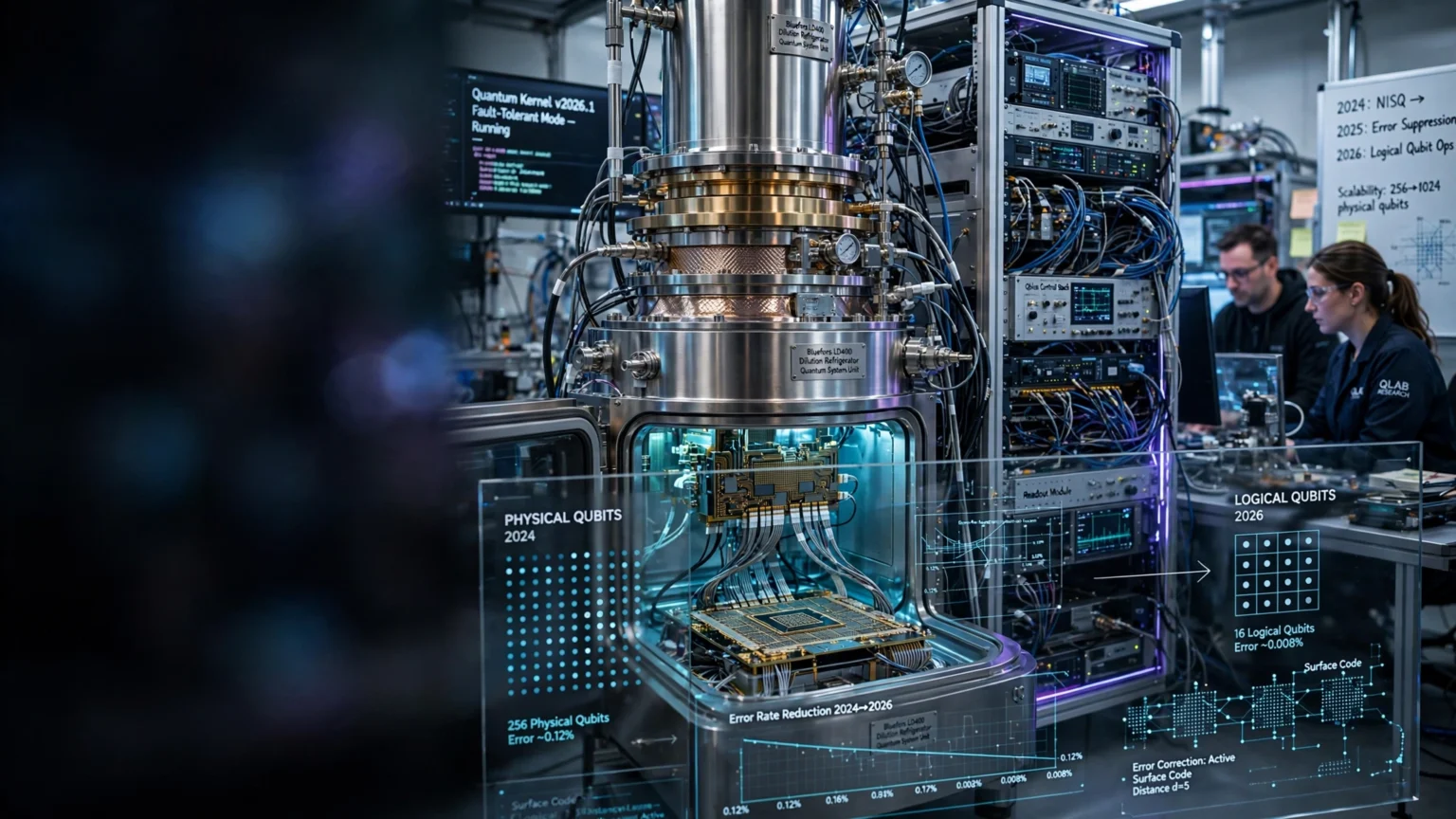
One of the biggest conceptual developments in modern quantum computing is the distinction between physical and logical qubits.
A physical qubit is an actual hardware element that can experience noise and errors.
A logical qubit is an error-corrected unit of quantum information constructed using multiple physical qubits.
This creates a difficult engineering challenge because building a powerful fault-tolerant quantum computer may require a very large number of physical qubits for every logical qubit.
Consequently, simply increasing the raw qubit count is no longer considered sufficient evidence of progress.
Researchers increasingly evaluate quantum systems according to logical performance, error rates, connectivity, circuit depth, and the reliability of operations.
Advances in Quantum Processors
Quantum processors have continued to improve through advances in fabrication, control electronics, materials, device architecture, and calibration techniques.
Different hardware approaches are competing to become practical foundations for large-scale quantum computing.
Superconducting qubits remain an important approach, particularly because they can be manufactured using techniques related to established semiconductor and microfabrication technologies.
Trapped-ion systems offer highly controlled quantum states and strong gate performance, although scaling the technology presents substantial engineering challenges.
Neutral-atom platforms have also attracted significant attention because large groups of atoms can be manipulated using optical systems.
Photonic quantum computing takes a different approach by encoding information into particles of light, potentially offering advantages in communication and specialized architectures.
Other approaches, including silicon-based spin qubits and topological concepts, continue to be investigated as potential routes toward scalable quantum hardware.
Quantum Error Rates Are Becoming a Key Metric
The quality of quantum operations is becoming just as important as the number of available qubits.
Quantum gates are not perfectly reliable, and even small error probabilities become significant when a computation requires many operations.
Improving gate fidelity allows quantum circuits to become deeper and more sophisticated before accumulated errors overwhelm the calculation.
This is particularly important for error correction because fault-tolerant architectures require physical operations to be sufficiently reliable for the correction process to provide a net benefit.
The long-term objective is not merely to make individual qubits better, but to build complete systems in which logical information can be protected while useful computations are performed.
Quantum Computing Benchmarks Are Evolving
Benchmarking quantum systems has become more complicated as the technology develops.
A single number, such as the total number of qubits, cannot adequately describe the capabilities of a quantum processor.
Modern evaluation increasingly considers factors such as gate fidelity, coherence, connectivity, circuit performance, error rates, algorithmic performance, and logical-qubit behavior.
This shift makes comparisons between quantum systems more meaningful because it focuses attention on what the hardware can actually accomplish.
Quantum Advantage and Practical Utility
Quantum advantage refers broadly to situations in which a quantum computer performs a computational task more effectively than a conventional approach.
Demonstrating a quantum computation that is difficult for classical computers is scientifically significant, but it does not automatically mean that quantum computing has become commercially useful.
A practical quantum advantage would need to address a problem with meaningful real-world value while offering performance that justifies the complexity and cost of the quantum system.
Researchers therefore increasingly distinguish between experimental demonstrations and applications capable of producing measurable practical benefits.
Advances in Quantum Algorithms
Hardware improvements are only one part of quantum computing.
Researchers are also developing and refining algorithms designed for quantum processors.
Quantum algorithms are being explored for areas such as molecular simulation, optimization, cryptography, linear algebra, materials science, and machine learning.
Some algorithms require extremely powerful fault-tolerant systems and therefore remain long-term goals.
Others are designed for noisy quantum processors and attempt to extract useful information before full fault tolerance becomes available.
Quantum Computing and Artificial Intelligence
The relationship between quantum computing and artificial intelligence has become an increasingly discussed research area.
Quantum machine learning explores whether quantum systems can accelerate or improve particular machine-learning tasks.
Researchers are investigating quantum approaches to optimization, feature processing, sampling, and other computational components associated with artificial intelligence.
However, practical quantum acceleration for mainstream AI remains an open research question.
Conventional computing hardware, including GPUs and specialized AI accelerators, continues to provide the overwhelming majority of practical AI computing capacity.
Quantum computing should therefore be viewed as a potential specialized technology rather than a replacement for conventional AI infrastructure.
Quantum Computing for Drug Discovery
One of the most frequently discussed applications of quantum computing is molecular simulation.
Chemical systems are governed by quantum mechanics, making them theoretically suitable targets for quantum simulation.
A sufficiently capable quantum computer could potentially model molecular interactions with greater accuracy for certain problems than is practical using classical computational methods.
This could eventually support research into pharmaceuticals, catalysts, batteries, and advanced materials.
The challenge is that many commercially meaningful simulations require fault-tolerant quantum computers with substantially greater capabilities than today’s broadly available systems.
Quantum Computing and Materials Science
Materials discovery is another promising research direction.
Scientists want to understand how electrons and atoms interact inside materials so that they can design substances with desirable properties.
Quantum computers could eventually simulate complex quantum systems and help researchers investigate materials that are difficult to model using conventional methods.
Potential applications include improved batteries, superconducting materials, catalysts, solar technologies, and other advanced materials.
The practical impact will depend on whether future quantum systems can perform sufficiently large and accurate simulations.
Quantum Optimization
Optimization problems occur throughout logistics, transportation, manufacturing, finance, scheduling, and supply-chain management.
Quantum computing researchers have developed algorithms intended to address certain optimization problems using quantum methods.
However, optimization is particularly challenging because many quantum algorithms have to compete against highly optimized classical algorithms.
The important question is therefore not whether a quantum algorithm can solve an optimization problem, but whether it can provide a meaningful advantage over the best available conventional methods.
The Continued Importance of Cryptography
Quantum computing has significant implications for cybersecurity.
A sufficiently powerful fault-tolerant quantum computer could threaten some widely used public-key cryptographic systems.
This possibility has encouraged governments, businesses, researchers, and security organizations to investigate post-quantum cryptography.
Post-quantum cryptographic methods are designed to resist attacks from both conventional and future quantum computers.
The transition is particularly important because sensitive information encrypted today could potentially be collected and stored for future decryption if sufficiently capable quantum machines become available.
Quantum Networking and the Quantum Internet
Quantum computing research is increasingly connected to quantum communication.
A future quantum network could use quantum states to transmit information and connect quantum processors across different locations.
Quantum networking is still at an early stage, but researchers are investigating technologies such as quantum repeaters, entanglement distribution, quantum memories, and photonic communication.
A fully developed quantum internet would not simply be a faster version of today’s internet.
Instead, it would introduce new communication capabilities based on the properties of quantum information.
Improvements in Quantum Control
Quantum processors require extremely precise control.
Researchers must manipulate qubits, perform quantum gates, measure quantum states, and maintain synchronization while minimizing unwanted interactions.
Control electronics and calibration systems have therefore become important areas of quantum-computing development.
Automation and machine-learning techniques are increasingly being investigated to help calibrate complex quantum hardware.
Better control can improve reliability while also reducing the engineering effort required to operate increasingly large processors.
The Role of Software
Quantum hardware cannot reach its potential without appropriate software.
Quantum software includes programming languages, development environments, compilers, simulators, error-mitigation techniques, circuit optimizers, and tools for connecting quantum processors with conventional computers.
Compilers are particularly important because a high-level quantum algorithm must ultimately be translated into operations supported by a particular processor.
Efficient compilation can reduce unnecessary operations and help limit the impact of noise.
Hybrid Quantum-Classical Computing
Most practical quantum systems are not standalone machines.
Instead, they operate as part of hybrid systems in which conventional computers handle many tasks while quantum processors execute specialized quantum circuits.
A classical computer may prepare data, manage the experiment, optimize parameters, analyze measurement results, and determine what quantum computation should be performed next.
This hybrid approach is likely to remain important because quantum processors are specialized computational devices rather than general-purpose replacements for classical computers.
Challenges Facing Quantum Computing
Despite rapid progress, quantum computing still faces substantial obstacles.
One of the biggest challenges is maintaining quantum coherence long enough to perform useful computations.
Quantum states can be disturbed by environmental noise, imperfections in hardware, unwanted interactions, and control errors.
Another major challenge is scaling.
A system with a small number of high-quality qubits is considerably easier to operate than a machine containing the very large number of reliable qubits that may ultimately be required for complex fault-tolerant applications.
The Scaling Problem
Scaling quantum computers involves much more than adding additional qubits.
More qubits create additional requirements for control electronics, wiring, cooling, calibration, error correction, communication, and system architecture.
The hardware must remain reliable as the system grows.
This creates a difficult engineering trade-off: increasing scale can introduce additional sources of complexity and error.
Solving this problem is one of the central objectives of the quantum-computing industry.
Energy and Infrastructure Requirements
Some quantum technologies require specialized environments.
Superconducting quantum processors, for example, operate at extremely low temperatures and require sophisticated cryogenic infrastructure.
Other architectures require precision lasers, vacuum systems, optical equipment, or highly controlled environments.
As quantum computers scale, reducing the physical and energy requirements associated with operating them will become increasingly important.
A commercially useful quantum computer must not only perform valuable computations but also operate within a practical technological and economic infrastructure.
The Talent and Skills Challenge
Quantum computing requires expertise across several disciplines.
Physicists, electrical engineers, computer scientists, mathematicians, materials scientists, software developers, and other specialists all contribute to the development of quantum systems.
This interdisciplinary nature creates both opportunities and challenges.
As the field grows, universities and companies are developing educational programs and professional training designed to prepare researchers and engineers for quantum-related careers.
Quantum Computing in the Cloud
Cloud access has made quantum hardware more accessible to researchers, students, and developers.
Instead of physically owning a quantum computer, users can submit quantum circuits to remote processors and receive measurement results.
This model allows organizations to experiment with different quantum technologies without building their own laboratories.
Cloud-based quantum computing also supports education because students can gain hands-on experience with real quantum hardware alongside simulators.
What Quantum Computing Can and Cannot Do Today
Quantum computers are real and increasingly sophisticated, but they are not general-purpose replacements for conventional computers.
Today’s systems remain constrained by noise, limited scale, error rates, and the difficulty of performing long computations reliably.
For many everyday applications, conventional computers remain more practical, efficient, and economical.
Quantum computing is better understood as an emerging specialized computing technology whose strongest applications may appear as hardware and error-correction techniques continue to mature.
What Comes Next?
The next stage of quantum computing is likely to focus increasingly on fault-tolerant operation and useful logical qubits.
Researchers will continue working to reduce error rates, improve error-correction overhead, increase logical-qubit quality, and develop architectures capable of scaling.
The transition from noisy experimental processors to reliable quantum computers will not happen through a single breakthrough.
It will require simultaneous progress in hardware, software, error correction, control systems, algorithms, manufacturing, and infrastructure.
The Importance of Logical Quantum Computing
Logical qubits are expected to become increasingly important in evaluating future quantum processors.
A logical qubit protected by error correction can potentially preserve quantum information much more reliably than an individual physical qubit.
As researchers demonstrate increasingly capable logical operations, attention will shift further away from raw hardware counts and toward the number and quality of logical resources available for useful computations.
This could become one of the most important measures of progress during the next phase of the industry.
Quantum Computing and Commercial Applications
Businesses are increasingly experimenting with quantum technologies, particularly in sectors where difficult computational problems could potentially provide economic value.
Financial modeling, pharmaceuticals, chemistry, logistics, manufacturing, energy, cybersecurity, and materials research are among the areas receiving attention.
However, commercial adoption remains closely tied to whether quantum systems can demonstrate advantages that justify their operational costs and complexity.
The transition from research demonstrations to widespread commercial use will therefore depend on measurable application-level benefits.
How Businesses Should Prepare
Organizations interested in quantum computing do not necessarily need to purchase quantum hardware.
A more practical starting point can be understanding which computational problems within the organization might eventually benefit from quantum methods.
Companies can also evaluate their exposure to quantum-related cybersecurity risks and begin considering migration toward post-quantum cryptographic technologies where appropriate.
Developing internal knowledge can help organizations understand both the potential opportunities and the limitations of emerging quantum technologies.
The Role of Governments and Research Institutions
Government programs and research institutions play an important role in quantum technology development.
Quantum research often requires long-term investment because hardware development, fundamental research, infrastructure, and workforce development can take many years.
Public research funding can support areas that may not produce immediate commercial returns but could become important foundations for future technologies.
International collaboration and competition are also influencing the development of quantum computing, with different countries investing in hardware, software, education, standards, and quantum communication.
Is Quantum Computing Ready for Mainstream Use?
Quantum computing is progressing rapidly, but mainstream adoption remains dependent on several unresolved technical and economic questions.
The central challenge is not simply building larger quantum processors.
Researchers must demonstrate that increasingly large systems can maintain sufficiently low error rates and execute useful algorithms reliably.
For this reason, the development of practical fault-tolerant quantum computing remains one of the most important long-term objectives in the field.
The Outlook for 2026 and Beyond
The quantum-computing landscape in 2026 reflects a field transitioning from proof-of-concept experiments toward increasingly serious engineering challenges.
The emphasis is shifting toward reliability, logical qubits, error correction, scalability, useful algorithms, and real-world applications.
Future progress will likely be measured by the ability to combine these elements into complete systems rather than by improvements in any single specification.
The most meaningful breakthroughs may therefore come from integration.
A processor with better qubits, a stronger error-correction system, more efficient control electronics, and improved software could ultimately matter more than a processor that simply advertises a larger raw qubit count.
Conclusion
The period from 2024 to 2026 has been an important chapter in the development of quantum computing.
Researchers have continued making progress in quantum processors, error correction, logical qubits, control systems, software, algorithms, networking, and potential applications.
At the same time, significant challenges remain.
Noise, scalability, error-correction overhead, infrastructure requirements, algorithmic limitations, and the difficulty of demonstrating practical quantum advantages continue to shape the industry’s development.
The next era of quantum computing will likely focus less on demonstrating that quantum processors can perform interesting experiments and more on proving that increasingly reliable quantum systems can solve meaningful problems.
As hardware and software continue to advance, quantum computing could become an important component of the broader computing ecosystem.
Its eventual role may not be to replace conventional computers, but to work alongside them as a specialized technology for problems where quantum mechanics provides a computational advantage.