
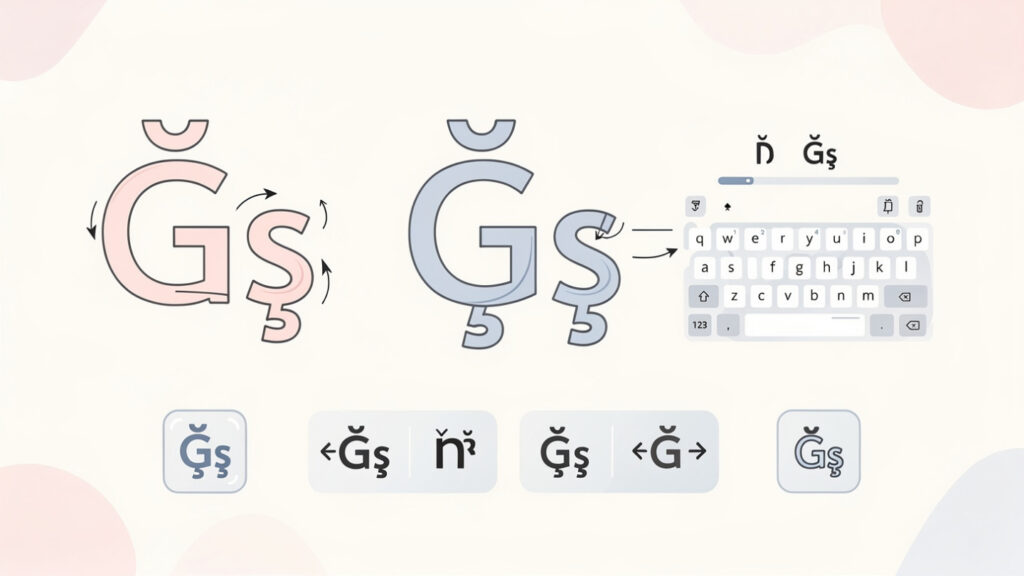
The character combination “Ğş” often appears when people are exploring the Turkish alphabet, testing international keyboard layouts, or searching for special characters online.
Although “Ğş” is not a standalone Turkish word, it combines two important letters—Ğ and Ş—that play essential roles in the pronunciation and spelling of the Turkish language.
For learners, translators, and keyboard users, understanding these two characters is an important step toward mastering written Turkish.
Their distinctive appearance and unique sounds make them among the most recognizable letters in the Turkish alphabet.
What Does Ğş Mean?
The combination “Ğş” does not have a specific dictionary meaning in Turkish.
Instead, it is simply a pairing of two separate letters from the 29-letter Turkish alphabet.
People often type or search for “Ğş” when they want to copy these characters, learn how they are pronounced, or configure a Turkish keyboard.
Because both letters are unfamiliar to many non-native speakers, they frequently attract curiosity.
The real significance lies in the individual functions of Ğ and Ş rather than in the combination itself.
The Turkish Alphabet and Its Special Characters
The modern Turkish alphabet was introduced in 1928 as part of language reforms led by Mustafa Kemal Atatürk in Turkey.
It uses the Latin script but includes several unique letters that are not found in standard English.
These include Ç, Ğ, I, İ, Ö, Ş, and Ü.
Each character has a fixed pronunciation, making Turkish highly phonetic and relatively straightforward to read once the alphabet is understood.
Among these special letters, Ğ and Ş are particularly notable.
How to Pronounce Ğ (Yumuşak G)
The letter Ğ is called “yumuşak g,” which means “soft g” in Turkish.
Unlike ordinary consonants, Ğ rarely produces a distinct sound.
Instead, it lengthens the vowel before it or creates a gentle glide between two vowels.
For example, in the word “dağ” (mountain), the letter Ğ extends the “a” sound rather than being pronounced as a hard “g.”
This subtle feature contributes to the smooth and melodic quality of spoken Turkish.
How to Pronounce Ş
The letter Ş is pronounced like the English “sh” sound.
It appears in many common Turkish words, such as “şeker” (sugar), “şehir” (city), and “şarkı” (song).
The cedilla beneath the letter distinguishes it from the standard letter S.
Because English speakers are already familiar with the “sh” sound, Ş is usually easy to learn and pronounce correctly.
Its pronunciation remains consistent in every word.
Why Ğ and Ş Matter in Turkish
Both Ğ and Ş are critical to accurate spelling and pronunciation.
Changing or omitting these letters can alter the sound and sometimes the meaning of a word.
For instance, “güneş” means sun, and the Ş at the end gives the word its final “sh” sound.
Similarly, Ğ helps maintain the proper rhythm and vowel structure in countless words.
These letters are integral to the identity and readability of the Turkish language.
Common Words Featuring Ğ
The soft g appears in a wide variety of everyday Turkish vocabulary.
Examples include “yağ” (oil), “soğuk” (cold), “doğru” (correct), and “uğur” (good fortune).
In each case, Ğ modifies the surrounding vowels rather than introducing a strong consonant sound.
Recognizing this pattern is essential for natural pronunciation.
With regular listening practice, learners begin to hear the effect more clearly.
Common Words Featuring Ş
The letter Ş is equally common and highly visible in written Turkish.
Words such as “şarap” (wine), “taş” (stone), “şemsiye” (umbrella), and “güneş” (sun) all contain this distinctive character.
Because Ş always represents the same “sh” sound, it provides consistency and predictability.
This makes Turkish spelling easier to understand and reproduce accurately.
Mastering Ş quickly improves reading confidence.
How to Type Ğ and Ş on a Keyboard
Typing Turkish characters is simple once the correct keyboard layout is enabled.
On Windows and Mac computers, users can add Turkish as an input language through system settings.
On smartphones and tablets, holding down the letters G or S reveals options for Ğ and Ş.
These characters are fully supported by Unicode, ensuring compatibility across websites, documents, and applications.
This universal support makes it easy to write in Turkish from almost any device.
Keyboard Shortcuts for Ğ and Ş
Users who frequently type Turkish may prefer keyboard shortcuts or character maps.
In Microsoft Word, special characters can be inserted using the Symbol menu.
On Windows, the Character Map utility allows users to copy and paste letters such as Ğ and Ş.
Mac users can access the Character Viewer to insert accented and language-specific letters.
For most people, however, switching to the Turkish keyboard layout is the fastest and most convenient option.
Why People Search for “Ğş”
The term “Ğş” is commonly searched by language learners, translators, and web users who encounter unfamiliar Turkish characters.
Some people need the letters for copy-and-paste purposes, while others are curious about their pronunciation.
It is also a common test string used to verify that Turkish fonts and keyboard settings are working properly.
Because the letters are visually distinctive, they often stand out to anyone new to the language.
This curiosity reflects the increasing global interest in Turkish culture and communication.
Final Thoughts
Understanding “Ğş” is less about discovering a hidden word and more about learning two of the most unique letters in the Turkish alphabet.
Ğ, the soft g, subtly extends vowel sounds, while Ş provides the familiar “sh” pronunciation.
Together, they demonstrate the phonetic precision and elegance of written Turkish.
Whether you are studying the language, configuring your keyboard, or simply exploring special characters, mastering Ğ and Ş will deepen your understanding of Turkish pronunciation and spelling.
These small symbols carry significant importance and reveal the richness of one of the world’s most fascinating languages.